Daily mind-download cycle
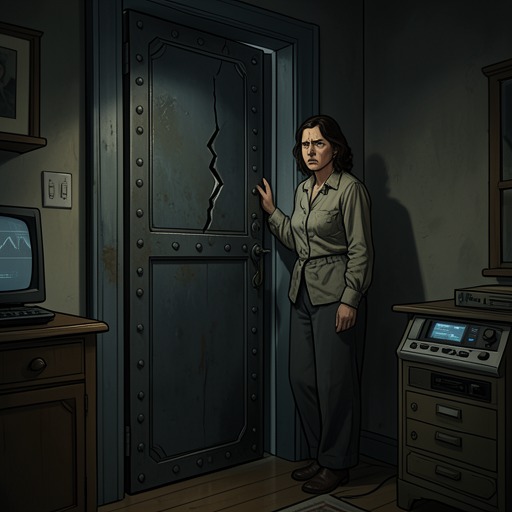
Made for LoveThe Daily mind-download cycle is the recurring transfer of Hazel’s mental experiences and location to Byron through a concealed Brain-implant chip. Its decisive significance lies in joining surveillance to bodily coercion: Byron does not merely learn what Hazel has thought and done; the daily process also leaves her vulnerable to episodes of paralysis and shock, while its location report makes escape temporary.
Operation and Scope
Byron describes Hazel’s mind as a camera. He challenges her to ask about anything she has seen, thought, touched, or smelled during the preceding twenty-four hours, including memories formed while drunk. He claims that he may know more about those experiences than Hazel remembers herself. The cycle therefore reaches beyond a simple record of deliberate actions: Byron presents it as access to a broad stream of recent perception, thought, and memory.
The daily report also conveys Hazel’s exact coordinates. Byron explains that the prototype has no active GPS because such a device would be detectable; instead, each download supplies the location data. He tells Hazel that she would have a twenty-four-hour lead if she tried to flee, but could not keep outrunning the people seeking her indefinitely without resources. The arrangement makes the recurring transmission a tracking mechanism as well as a mental one. Its daily rhythm gives Hazel a temporary interval of relative distance, not lasting anonymity.
Discovery and Disclosure
When Byron asks how the download found her, Hazel rejects the premise that he has obtained information from her brain. She says she has even checked for a scar, but suspects there is no chip and that Byron wants her to believe there is one. Her skepticism makes the disclosure a contest over knowledge: what Byron presents as proof of the system’s reach, Hazel initially interprets as an attempt to manipulate her.
Byron answers her doubts by inviting her to test him on the last twenty-four hours, including the parts of the previous night she cannot readily recall. Hazel counters that he sounds like a psychic and could make his guesses appear accurate by prompting her to supply information. The exchange shows why the cycle is difficult for her to verify from the outside: the evidence Byron offers is itself entangled with the possibility that he is bluffing. He nevertheless insists the implant has been in place for some time and says he activated it after Hazel left because he missed her. He describes implantation as safe and scarless, and warns that ordinary hospital scans would not reveal the device. The concealed installation means Hazel’s lack of a visible mark cannot settle the question.
Daily Timing and Physical Cost
The cycle imposes a schedule on Hazel even before a download occurs. The next morning, she wakes without knowing the time and worries that she must reach her father’s house before the next transmission at noon. Liver’s pickup has no functioning clock; on the way, they pass a pharmacy marquee showing 11:32 AM. That mundane display becomes a measure of how little time Hazel believes she has before the event.
Hazel expects the download to bring on a seizure-like episode. She tells Liver that if she begins shaking, vomits, or passes out, he should wait for it to pass. Later, she summarizes the arrangement as a daily report of her thoughts and activities, followed each afternoon by an inconvenient state of paralysis and shock. Her description makes clear that the procedure’s effects are not limited to data transfer: the recurring process has an immediate bodily cost that she must anticipate and endure. The references to noon and afternoon establish its daily timing, though Hazel’s urgency centers on getting home before the expected noon download.
Surveillance in Ordinary Life
Once Hazel understands what the cycle may reveal, ordinary actions acquire a new audience. She imagines Byron learning what she sees every time she goes to the bathroom. Rather than avert her gaze or make herself less visible, she decides to look for longer. The response is a small assertion of control over an experience she cannot keep private: if the system turns even routine perception into reportable data, she will not voluntarily discipline her own attention for Byron’s comfort.
An ant crawling across Hazel’s leg sharpens the imbalance. She considers crushing it, then recognizes the comparison that makes her feel like an ant on Byron’s leg. She also anticipates his delight at learning, in the next download, both the thought and her horror at his future knowledge of it. The cycle thus threatens to absorb even resistance into its record. A private thought about being watched may itself become material for the watcher, extending surveillance from actions and locations into Hazel’s awareness of surveillance.
Significance
Byron frames the system as a way to remain present in Hazel’s life, claiming that her life means everything to him even though she would rather not spend it with him. The cycle gives that claim a coercive form: intimacy is replaced by access that Hazel has not chosen, and care is made inseparable from monitoring. His language of missing her sits against the practical consequences he describes—hidden implantation, daily bodily distress, and coordinates that can disclose where she has gone.
For Hazel, the central consequence is that escape no longer means simply leaving Byron’s immediate presence. Each day brings a new report and a renewed obligation to reckon with its timing, physical effects, and reach. The cycle’s repetition is what makes it powerful: a single transmission would expose information, but a daily one continually narrows the distinction between Hazel’s private experience and Byron’s knowledge of her.